
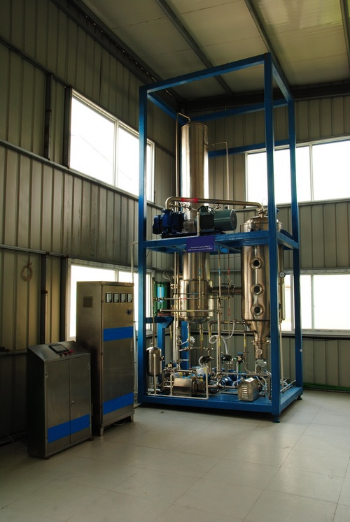
Vobis vapor compression evaporators (VCE), also called mechanical vapor recompression evaporators (MVR), operate via an electrical heat pump principle. Water or other volatile component is evaporated, and then the vapor is recompressed mechanically by a highly efficient compressor, fan or blower, increasing its saturation temperature and releasing its latent heat.
Our vapor compression evaporation systems are manufactured in a wide variety of materials of construction for process wetted components, dependent upon the application requirements. Appropriate materials can include various stainless steels, Duplex steels, and titanium. Allen Bradley or Siemens PLC control systems are typically implemented to accurately and reproducibly control our mechanical vapor recompression evaporation systems. Skid mounting where appropriate allows easy installation as well as ready access to all piping, control elements, and process vessels.
Vobis vapor compression evaporators or MVR evaporators are more energy efficient and are thus more cost-effective than multiple effect evaporators because of the very high efficiency of the electrical compressor, blower and/or fan that is implemented at the heart of the system. Only electrical energy is needed; neither steam nor cooling water is required during operation, so, they can be implemented where steam is unavailable. Unlike thermal vapor compression evaporators, mechanical compressors eliminate the need for any steam once the system is operational. Our VCE (MVR) production systems utilize either a single or a multiple effect falling film or plate evaporator which has the added advantage of requiring only a small product inventory.
The implementation of production scale Vobis vapor compression evaporation systems enable low temperature operation under vacuum operating conditions which is important for heat sensitive materials, have low energy consumption, and can eliminate cooling water as a necessity for condensation.